

The Latin American Institute for Environmental Studies was founded with a purpose: to transform knowledge into actions that make a difference in peoples lives..
Projects that turn knowledge into action
The *Medicinal Plants in Brazilian Education* project, developed by ILLEA, brings knowledge about medicinal plants, biodiversity, and environmental education to schools, communities, and institutions. This initiative values ??traditional knowledge, connects people with nature, and fosters a conscious, responsible relationship with natural resources.
Meanwhile, the *Raízes da Terra (Roots of the Earth) Social Project* seeks to strengthen communities through sustainability, social inclusion, and the creation of opportunities. By utilizing community nurseries, cultivating medicinal and aromatic plants, producing native seedlings, and offering training and support for sustainable production, the project unites *environmental preservation, cultural appreciation, and economic development*.
ILLEA — where knowledge, nature, and community put down roots to transform the future.*
The *Medicinal Plants in Brazilian Education* project, developed by ILLEA, brings knowledge about medicinal plants, biodiversity, and environmental education to schools, communities, and institutions. This initiative values ??traditional knowledge, connects people with nature, and fosters a conscious, responsible relationship with natural resources.
Meanwhile, the *Raízes da Terra (Roots of the Earth) Social Project* seeks to strengthen communities through sustainability, social inclusion, and the creation of opportunities. By utilizing community nurseries, cultivating medicinal and aromatic plants, producing native seedlings, and offering training and support for sustainable production, the project unites *environmental preservation, cultural appreciation, and economic development*.
ILLEA — where knowledge, nature, and community put down roots to transform the future.*
Data: 2027-08-28
Hora: 1800
MORE EVENTS
The institution aims for sustainable development and transformation, valuing people, cultures, and Brazilian craftsmanship
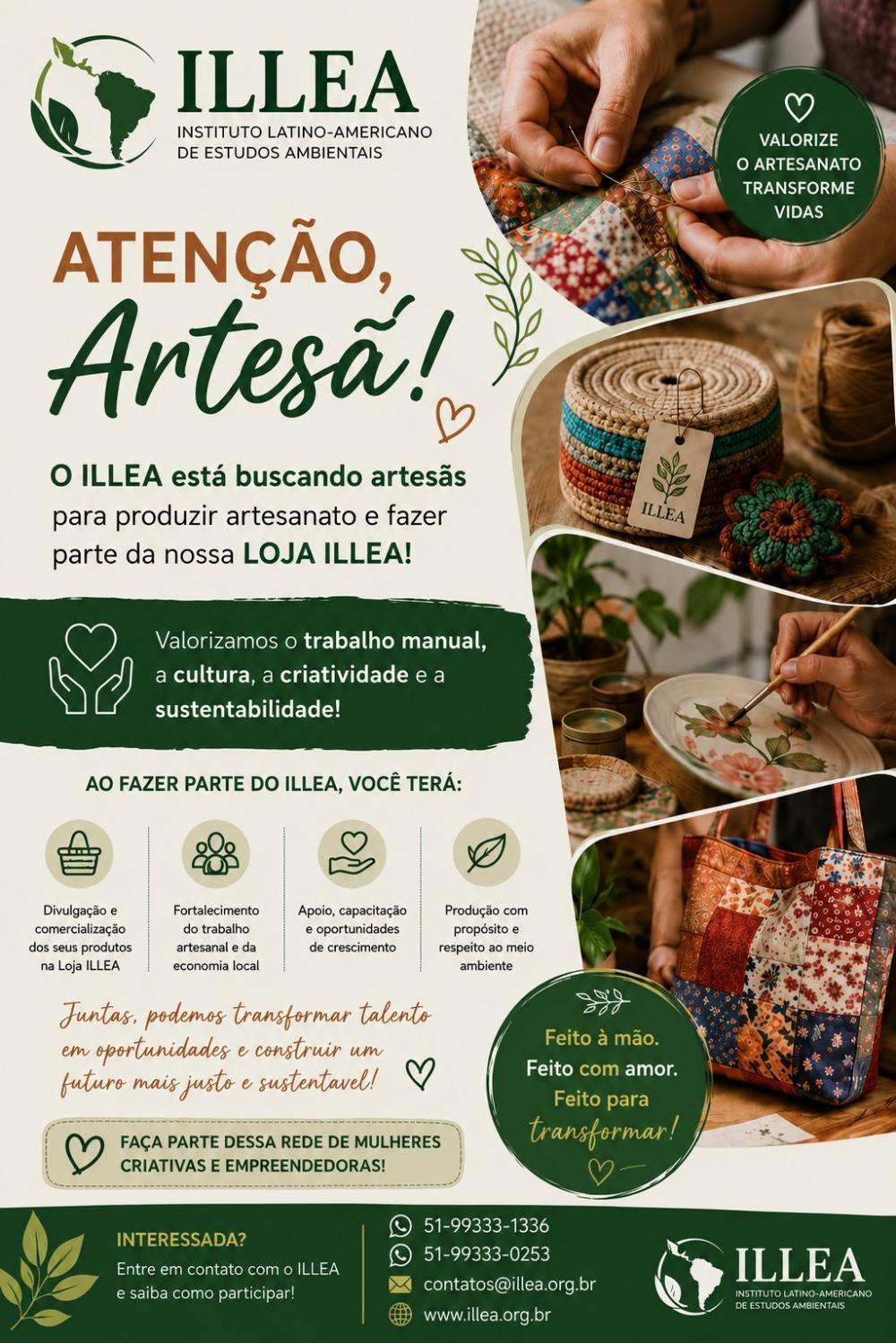 The Latin American Institute for Environmental Studies (ILLEA) CNPJ 08.547.139-0001-61 is seeking artisans from across Brazil to join the producer network for the upcoming ILLEA Store—a space dedicated to celebrating craftsmanship, Brazilian culture, and sustainability.
If you create handmade goods, crafts, creative products, or items that honor traditional knowledge, we would love to see your work. Our goal is to bring together talented individuals who share values ??such as social responsibility, respect for the environment, creativity, and a commitment to quality.
The ILLEA Store will serve as a showcase for handmade products, fostering income generation, strengthening the local economy, and highlighting the artisans who keep Brazils rich cultural heritage alive. Every item sold will tell a story, reflecting the talent, dedication, and identity of its creator.
We are looking for artisans working with:
Natural fiber crafts;
Creative sewing and patchwork;
Embroidery and crochet;
Ceramics and pottery;
Woodworking;
Sustainable and eco-friendly products;
Handcrafted décor;
Bio-jewelry and accessories;
Folk and regional art;
Other handcrafted works with cultural and environmental significance.
Our sustainable products are created with a commitment to reducing environmental impact, promoting the responsible use of natural resources, and valuing human craftsmanship. More than just merchandise, they represent a conscious approach to production, consumption, and biodiversity preservation.
At ILLEA, we believe sustainability begins with responsible cultivation, embraces respect for traditional knowledge, and reaches the consumer through products that combine quality, social responsibility, and environmental conservation.
Join ILLEA and turn talent, culture, and creativity into opportunities to build a fairer, more sustainable, and more humane future.
ILLEA – Valuing people, cultures, and Brazilian craftsmanship.
Data: 2026-12-31
Hora: 1200
Production of Teas and Medicinal Plants within a Bioeconomy Future Project in Brazil – International Bioeconomy Program for Rural Women in Family Farming – ILLEA
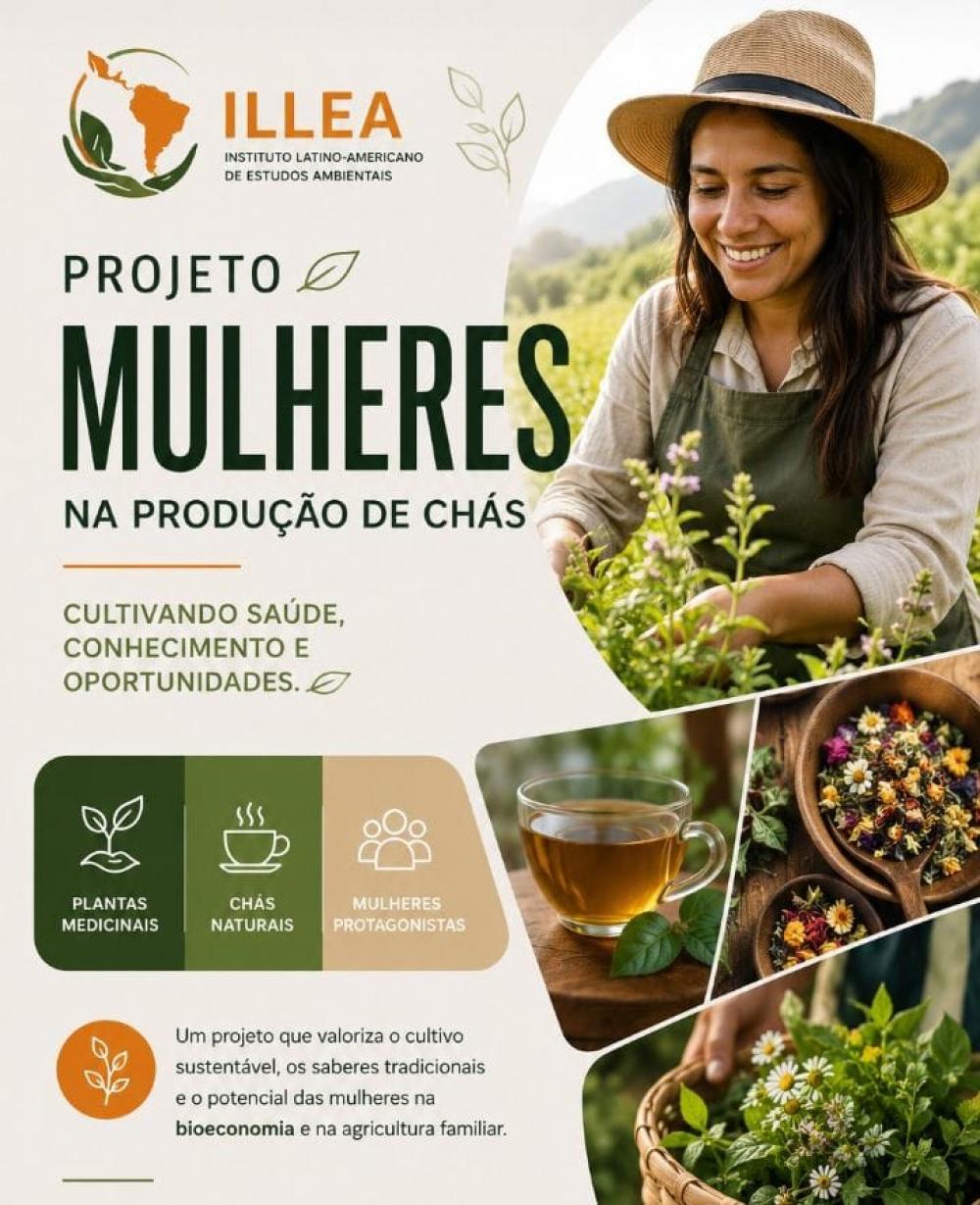 The Latin American Institute for Environmental Studies (ILLEA) believes that strengthening family farming depends on the leadership of women, guardians of traditional knowledge and Brazilian biodiversity. Through the Future in Bioeconomy in Family Farming Project, the Institute promotes opportunities for rural women to transform the cultivation of medicinal plants into a sustainable activity that generates income, well-being, and environmental conservation.
The project encourages the responsible cultivation of medicinal, aromatic, and condiment species, valuing agroecological practices and production systems that respect nature. In addition to preserving knowledge passed down through generations, it seeks to integrate technical and scientific knowledge to improve the quality of production of teas, dried herbs, seedlings, and other natural products.
Womens participation strengthens the diversification of agricultural production, increases the economic autonomy of families, and contributes to the construction of production chains based on the bioeconomy, adding value to Brazilian biodiversity resources in a sustainable way.
ILLEA will offer technical guidance, training, encouragement of entrepreneurship, support for production organization, and marketing opportunities through the future ILLEA Store, promoting products cultivated with socio-environmental responsibility and quality.
More than just producing teas, the project promotes the cultivation of health, knowledge, environmental preservation, and local development. Each cultivated plant represents an opportunity to strengthen family farming, conserve biodiversity, and build a more sustainable future for the next generations.
ILLEA – Bioeconomy Future Project
Cultivating plants, empowering women, creating opportunities, and building a sustainable future for family farming.
Data: 2026-07-26
Hora:
Connect * Educate * Transform * Towards a Sustainable Future
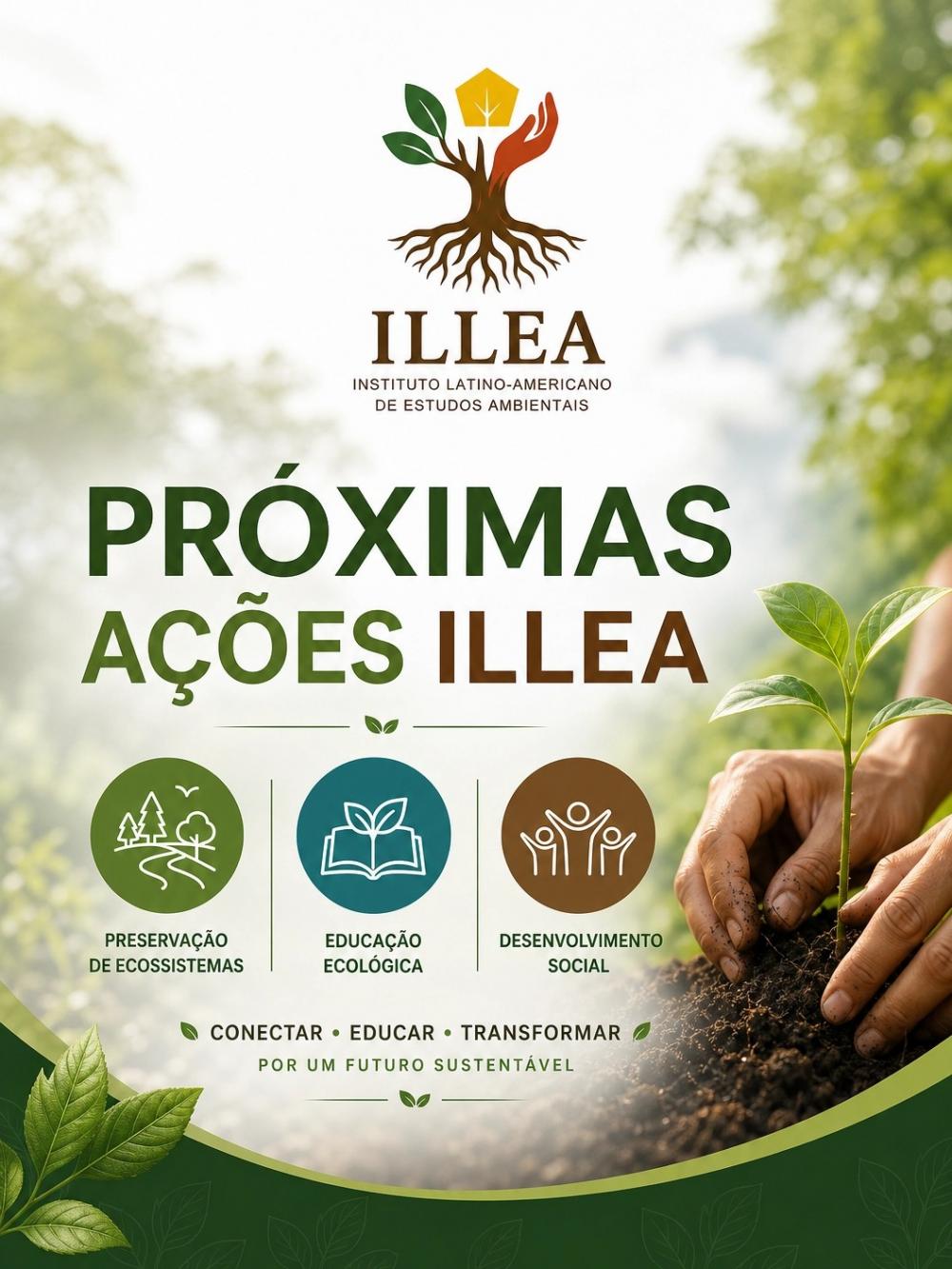 The ILLEA Institute will announce its next actions. ILLEA reaffirms its role as a facilitator of environmental and social solutions with the announcement of its new calendar of activities. Our next actions will focus on fundamental pillars such as the preservation of ecosystems, ecological education, and the strengthening of social development.
The ILLEA Institute will announce its next actions. ILLEA reaffirms its role as a facilitator of environmental and social solutions with the announcement of its new calendar of activities. Our next actions will focus on fundamental pillars such as the preservation of ecosystems, ecological education, and the strengthening of social development.
Stay tuned to our official channels. We are preparing events that promote qualified debate and the implementation of green economy and family farming practices.
The preservation of ecosystems is fundamental to maintaining the balance of life on the planet. An ecosystem is the set of living beings (plants, animals, fungi, and microorganisms) and non-living elements (water, soil, air, and climate) that interact in a given region.
Why preserve ecosystems?
Protection of biodiversity: prevents the extinction of species.
Water and air quality: forests, rivers, and oceans help purify essential resources.
Climate regulation: healthy ecosystems contribute to reducing the impacts of climate change.
Food security: many foods depend on fertile soils, pollinators, and balanced natural cycles.
Human well-being: provides natural resources, leisure, and health benefits.
Ecological education is the process of teaching and learning about the environment, ecosystems, and the relationship between human activities and nature. Its goal is to develop environmental awareness and encourage responsible attitudes toward the conservation of natural resources.
Importance of ecological education
Promotes respect for nature and biodiversity.
Encourages conscious consumption and waste reduction.
Helps to understand environmental problems such as pollution, deforestation, and climate change.
Forms citizens capable of participating in actions in favor of sustainability.
Stimulates practices such as recycling, reuse of materials, and preservation of green areas.
Social development contributes to reducing inequalities, strengthening communities, improving the well-being of the population, and creating conditions for more sustainable economic growth.
Data: 2026-05-20
Hora: 1800
The Institute will be present at Fenachim.
 The Institute Will Be Present at Fenachim
In Venâncio Aires Come Have a Chimarrão With Us The Latin American Institute of Environmental Studies – ILLEA will be present at Fenachim – the National Chimarrão Festival, April 30 to May 10, 2026 celebrating culture, tradition, and commitment to the environment.
We invite you to come have a chimarrão with us and learn more about our actions and projects focused on sustainability and socio-environmental transformation.
During the event, we will present initiatives that promote environmental education, encourage sustainable practices, and strengthen community engagement, connecting people, nature, and the future. Our work seeks to awaken ecological awareness, valuing the balance between development and environmental preservation.
Socio-environmental transformation is at the heart of the actions of the Latin American Institute of Environmental Studies – ILLEA. More than preserving the environment, we seek to promote a profound change in the way people relate to nature and society.
We believe that caring for the environment is also caring for people. Therefore, our initiatives combine education, ecological awareness, and sustainable development, encouraging practices that respect natural resources and strengthen communities.
Transformation happens when knowledge becomes action. Through educational projects, workshops, experiences, and community actions, we stimulate more responsible attitudes, promoting the conscious use of resources, the appreciation of biodiversity, and a collective commitment to the future.
This movement involves everyone: individuals, families, schools, producers, and institutions. By connecting traditional knowledge with scientific knowledge, we create pathways to sustainable solutions that generate real and lasting impact.
At Fenachim, we invite you to be part of this transformation. Come share a chimarrão with us and discover how small actions can generate big changes, contributing to a more balanced, just, and sustainable world.
Data: 2026-04-29
Hora: 1800
Special Chat: The Future of the Book "The Natural That Heals"
 Special Chat: The Future of the Book “The Natural That Heals”
The ILLEA Institute invites you to an inspiring and transformative meeting!
Soon, we will hold an exclusive chat about the future of the book “The Natural That Heals,” a work that values ??natural knowledge, traditional wisdom, and the connection between health, the environment, and sustainability.
It will be a special moment for exchanging ideas, reflections, and collective construction, bringing together people interested in natural practices, well-being, and environmental preservation. The event will also open space for dialogue about the books future directions, new perspectives, and initiatives related to the theme.
More than just a book, “The Natural That Heals” represents a movement to value traditional knowledge, ancestral wisdom, and natural practices that promote health, balance, and well-being. This event will be a space dedicated to reflecting on the role of this knowledge in the contemporary world, especially in the face of the environmental and social challenges we are experiencing.
During the meeting, the following topics will be addressed:
The importance of reconnecting with nature
The recovery of natural practices of care and health
The impact of sustainable knowledge on peoples lives
The future perspectives of the work and its developments
It will also be a unique opportunity for open dialogue, exchange of experiences and collective construction of ideas, bringing together participants, supporters, scholars and all those who believe in a more conscious and sustainable future.
A moment of listening, learning and inspiration.
An invitation to personal and collective transformation.
With this initiative, the ILLEA Institute reaffirms its commitment to environmental education, the promotion of holistic health and the strengthening of sustainable practices that respect life in all its forms.
Participate in this movement of awareness and transformation!
Data: 2026-03-28
Hora: 16 00
We will be present at Expoagro Afubra Family Farming.
 The appreciation of family farming is also linked to cultural preservation. Traditional knowledge, cultivation methods, and food practices are kept alive by these families, reinforcing regional identities and promoting more conscious and responsible production.
Family farming plays an essential role in sustainable development, food security, and the preservation of local cultures. It is a production model based on the work of the families themselves, who cultivate the land with knowledge passed down from generation to generation, maintaining a more balanced relationship with the environment.
This type of agriculture is responsible for a large part of the food that reaches the populations table daily, especially fresh products such as fruits, vegetables, legumes, and grains. Furthermore, it strengthens the local economy, generates jobs in rural areas, and contributes to keeping families in their communities, preventing rural exodus.
The knowledge passed down from parents to children includes planting techniques, soil management, the use of heirloom seeds, and sustainable farming methods that are often absent in industrial models. This knowledge contributes to more resilient production, adapted to climate change and less dependent on external inputs.
Therefore, investing in and supporting family farming means guaranteeing not only quality food, but also a fairer, more sustainable and balanced future for the whole of society.
Data: 2026-03-27
Hora: 08 00